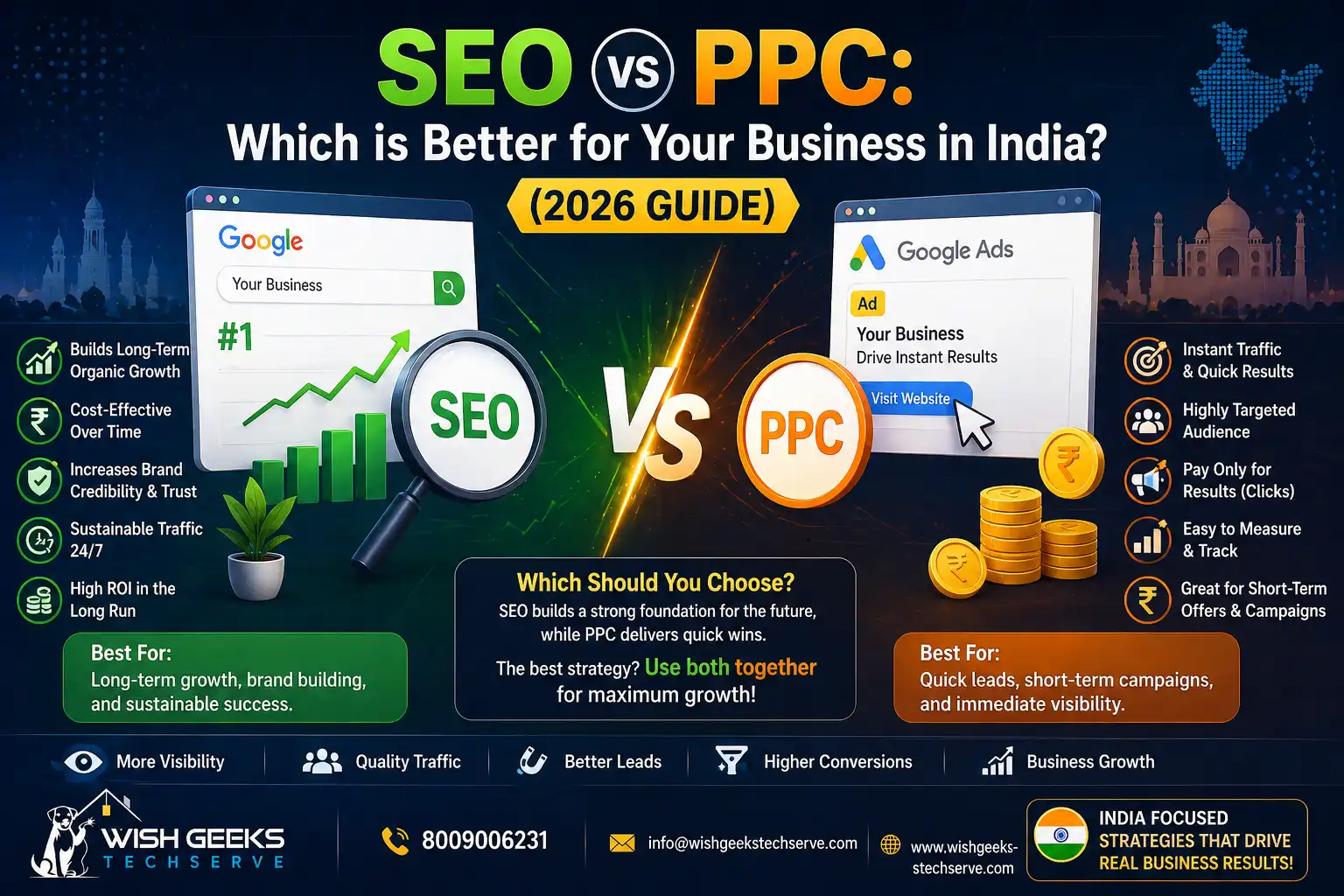
Picture this. You put months into building your product, got your website looking sharp, and then you Google your own business only to find your competitor staring back at you from position one. A competitor who launched after you did.
That stings. And it's exactly what pushes most Indian business owners into the SEO vs PPC rabbit hole.
There's no single correct answer, but there's a better way to consider it. This guide won't throw a vague "do both" at you and call it a day. We're going to break it down with actual numbers, real scenarios, and the kind of honest advice that helps you make a decision your business will thank you for.
SEO (Search Engine Optimization) is what you do to get Google to list your website for searches related to your business. "Best mobile app developer in Noida." "Affordable SaaS for small businesses in India". You want to be the Google search result, not your competitor.
It's built on three pillars:
SEO is like planting a mango tree. For a long time, it doesn't seem to be doing anything. You're watering it, fertilising it, and you're thinking, "Is this a waste of time?" Then it begins to bear fruit, and it bears fruit, and it bears fruit, and you don't have to pay for all the mangos.
A typical life cycle of most Indian businesses:
PPC (Pay-Per-Click) means you pay to have your ads show up at the top of Google, Instagram, Facebook, LinkedIn, wherever your audience is. You only pay when someone clicks.
Google Ads is where most Indian businesses start. Meta Ads (Facebook + Instagram) come second. LinkedIn is the go-to for B2B. YouTube is picking up fast.
The appeal is obvious: you can live within hours. Day one, traffic. Day one, potential leads.
But here's what usually doesn't get said clearly enough: the second your budget runs out, so does your traffic. Every bit of it. Gone. Unlike an SEO article that can rank and pull in leads for three years straight, PPC is a tap. You leave it open, water flows. You close it, nothing.
Also read: Why Your Website Is Not Getting Traffic? 7 Mistakes Killing Your Growth (2026 Guide)
Most of what's written about SEO vs PPC is aimed at Western markets. India is its own beast entirely.
Mobile isn't just important, it's everything. Over 85% of Indian internet users are on mobile. If your site takes more than 3 seconds to load on a 4G connection, you're bleeding both rankings and ad conversions. Site speed in India isn't "nice to have."
Vernacular keywords are a hidden goldmine. Searches in Hindi, Tamil, Telugu, and Marathi competition is almost nonexistent compared to English. A business targeting "data entry services Hyderabad" in Telugu is fighting maybe 10% of the competition. Most businesses haven't touched this yet. That's your opportunity.
WhatsApp beats Forms every single time. Indian users just don't fill out web forms the way Western audiences do. PPC campaigns that click directly into WhatsApp convert 3–4x better. Even on your SEO landing pages, a sticky WhatsApp button can quietly double your lead volume.
"Near me" searches keep growing. Local SEO through Google Business Profile regularly outperforms expensive national campaigns for service businesses. And it's free. If you run any kind of local service and you're not actively managing your Google Business Profile, you're giving away leads every day.
CPCs are rising. They're still cheaper than the US or UK, but the gap is narrowing as more Indian businesses pile into Google Ads. The window for cheap PPC here won't stay open forever, which is one more reason to start building SEO equity now.
Factor | SEO | PPC |
Time to Results | 3–9 months | Within 24–48 hours |
Cost Over Time | Front-loaded; traffic becomes essentially free | Ongoing, you pay forever |
What Happens When You Stop | Rankings stay (mostly) | Traffic drops to zero |
Trust Factor | More people trust organic results | Lower people know it's an ad |
Targeting | Keyword-based | Demographic, interest, intent, device |
Scalability | Slow but compounding | Instant double budget, double traffic |
Best Suited For | Long-term brand building | Quick wins, launches, time-sensitive offers |
Go with PPC, but plant SEO seeds alongside it. You need leads now. You need to figure out what messaging works and which customers actually convert. PPC gives you that data in weeks. Run the ads, generate the cash flow, and while you're at it, publish one solid blog post a month. You're building your long game while surviving the short one.
SEO and local SEO, hands down. A well-optimised Google Business Profile plus solid local SEO puts you in front of high-intent searches "CA in Jaipur," "plumber in Noida," "wedding photographer in Pune," essentially for free. Once you're ranking locally, the leads come without the ongoing ad spend. Use PPC to fill gaps in slow seasons.
PPC first, then build SEO underneath. You need immediate visibility to generate initial sales and reviews. Get the Google Shopping ads and Meta ads running. At the same time, start building your category and product page SEO so that by year two, you're not entirely dependent on your ad budget.
Yes, but in different roles, B2B customers do a lot of research. SEO content, tutorials, comparisons, and case studies help to earn their trust. But to target specific job roles or company sizes, LinkedIn Ads are still the best. SEO to get them, PPC to speed up.
PPC, full stop. You can't rank an SEO page in two weeks. You can run an ad today. Any time-sensitive offer lives in PPC territory.
Most businesses that have figured this out don't argue about which channel is better. They run them in sequence, with each one feeding the other.
Phase 1 - 1-3 months: PPC first. Advertise, get leads, pay the bills. But more importantly, learn. What keywords work? Which audiences respond? That's your SEO roadmap.
Phase 2 - Months 3-9: Build the SEO engine. Use your top-performing PPC keywords to create content. Fix technical issues. Improve load times. Start earning backlinks. You're building infrastructure now.
Phase 3 - Months 9 to 18: Change the balance. Once pages rank organically, reduce PPC spend on the keywords. Reallocate the funds to retargeting, to show ads to people who have visited your site. This is the highest ROI activity in digital marketing.
Phase 4 - 18 months and beyond: Compound growth. PPC is now focused only on your most valuable, bottom-of-funnel terms. Your cost per acquisition keeps dropping.
A mid-sized EdTech company in Bengaluru ran exactly this playbook. Starting point: ₹1,50,000/month in PPC, ₹800 cost per lead, and rising. Twelve months later: organic traffic at 50,000 visits/month, blended CPL under ₹350, and PPC spend cut by 60% without losing lead volume.
Chasing volume, not intent. Ranking for the term "what is digital marketing" attracts curious readers. Ranking for "digital marketing agency in Mumbai" brings paying clients. Always prioritise commercial intent first.
Sending PPC traffic to the homepage. Your homepage serves everyone. Your PPC landing page should serve one specific person with one specific offer. Businesses that skip this waste over half their ad budget.
Treating SEO as something you do once. "We had an agency do our SEO two years ago." This mindset is costing Indian businesses enormous money. SEO needs ongoing attention, Google updates, competitors publish new content, and rankings shift.
Ignoring Core Web Vitals. Google scores your site on loading speed, visual stability, and responsiveness. A slow, beautiful website is an SEO handicap, regardless of how good the content is.
Not retargeting organic visitors. Around 98% of visitors to your website leave without taking any action. A small retargeting budget to bring those people back is one of the most underused, highest-ROI moves in Indian digital marketing. Almost nobody at the SME level does it.
For SEO: Month-on-month organic traffic growth, ranking improvements on commercial keywords, organic leads, backlinks, and Core Web Vitals.
For PPC: Cost per click, click-through rate (healthy search ads hit 3-5%+), landing page conversion rate, cost per lead, return on ad spend.
For the integrated approach: Blended cost of customer acquisition over time, organic vs paid revenue share, brand search growth (a subtle but important indicator of your SEO success).
We've helped startups, D2C brands, SaaS, mobile apps, and enterprises in India. What we see over and over again: the fastest-growing companies are not the ones that chose the "right" channel. They're the ones who created a plan where all channels are working together.
We don't do cookie-cutter packages. We start by understanding your goals, your competitive situation, your budget, and your timeline, then we build something designed around your actual business, not some hypothetical average company.
Whether you need leads this month through performance-driven PPC, long-term organic growth through SEO, or an integrated strategy that uses both intelligently, we build it, run it, and optimize it as your business evolves.
The question was never really "SEO or PPC."
The real question is what your business needs right now, and what it will need 12 months from now.
That's where every good strategy starts. And it's where we'd love to begin with you.
Ready to stop guessing and start growing? Reach out to the Wish Geeks Techserve team and let's build a strategy that actually works for your business.
Q1. Will Google Ads improve my organic search rankings?
No, Google has said so. Indirectly, yes, in that more traffic can lead to more brand searches, possible backlinks, and other engagement factors that are important for organic rankings.
Q2. What should local service businesses do?
Prioritize local SEO and optimize your Google Business Profile. Being featured in the local 3-pack for high-intent keywords like "dentist near me" or "interior designer in Ahmedabad" can generate free leads. During the off-peak season, PPC can assist as well.
Q3. Can you do PPC with a ₹10,000/month budget?
It's tight in most industries. In very local, low-competition niches, it can work, but margins for error are small. At that budget level, SEO often builds more durable value over time.
Q4. How long until SEO pays off?
Most businesses' consistent effort starts seeing meaningful organic traffic in 4–6 months. Positive ROI where organic leads offset your SEO investment typically arrives around months 8–12 in competitive markets, earlier in niche or local ones.
Q5. What's the single biggest advantage of SEO?
It compounds. A page you publish today can generate leads for the next 3–5 years with minimal upkeep. No PPC campaign can do that. SEO builds an asset. PPC is a running expense.
Thank You for showing interest in our services. Here’s how you can reach us...

info@wishgeekstechserve.com

OUR ADDRESS
Sector-62, Noida, Uttar Pradesh




.7f54be30.webp&w=256&q=75)