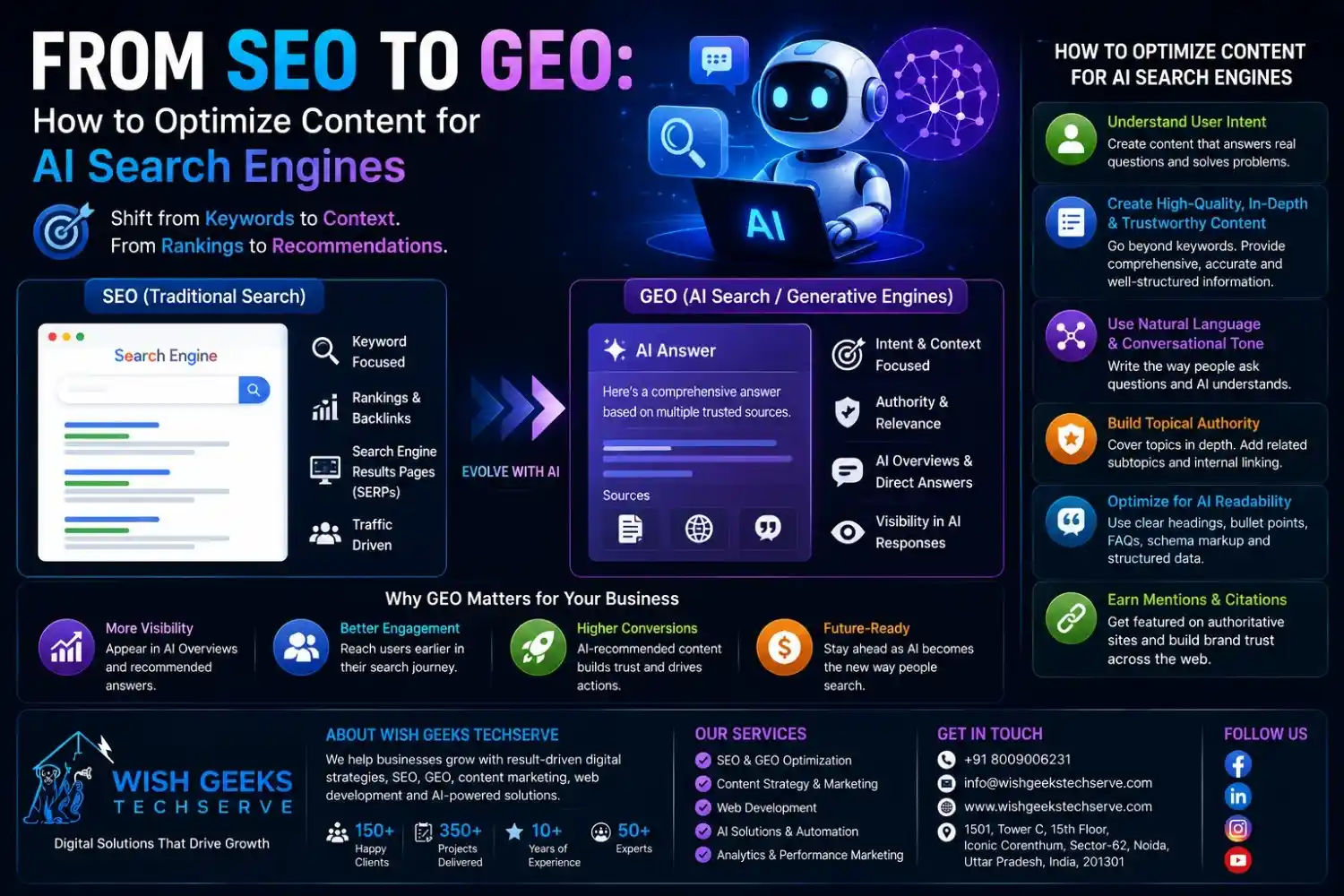
Imagine walking into a massive library. Instead of handing you a list of books and making you flip through the pages yourself, a smart assistant walks up to you. You ask a complex question, and the assistant instantly reads hundreds of books, pulls out the exact answers, and hands you a neat, friendly summary.
That is exactly how search is changing.
We are moving away from traditional Search Engine Optimization (SEO) and stepping into the era of Generative Engine Optimization (GEO). With tools like Google’s AI Overviews, ChatGPT, Perplexity, and Claude transforming how people find information online, businesses can no longer rely solely on old-school keyword stuffing.
If you want your business to be discovered, your content must speak directly to AI systems. How can you create content that AI engines are eager to quote? Let's deep dive into it for more accurate information.
Also Read: SEO vs PPC: Which is Better for Your Business in India? (2026 Guide)
Traditional SEO primarily focuses on improving the ranking of blue links on search results pages. GEO is the art and science of optimizing your website content so that AI search engines choose to pull, summarize, and cite your brand in their AI-generated answers.
An AI search engine doesn't simply display a website when asked a question, but rather compiles an answer from information gathered from trusted websites throughout the internet. As long as your content is well-organized, has authoritative information, and addresses the user's query, the AI will utilize your text and provide a valuable citation link to your website.
Feature | Traditional SEO | Generative Engine Optimization (GEO) |
Primary Goal | Rank on Page 1 of Search Engines | Get cited and sourced in AI summaries |
Strategy | Keyword targeting and backlink volume | Topical authority, direct answers, and deep context |
Content Format | Long blogs optimized for keyword density | Modular, authoritative content with data and FAQs |
How Success Looks | Higher click-through rates on organic links | Higher share of voice in AI responses |
AI engines do not read content the way older search systems did. They use advanced large language models (LLMs) to look for meaning, relationships between ideas, and absolute clarity.
Recent industry studies indicate that web pages featuring clear headings, direct answers, and well-organized data tables are up to 40% more likely to be referenced by AI engines. Furthermore, sections that answer a query right at the beginning get pulled into AI summaries 67% more often than those that hide the answer deep within long paragraphs.
If your content is too technical and difficult to understand, or not structured, AI crawlers will not read your content. With the ongoing development of AI-driven search, it's no longer an option to have a well-structured and technically optimized website; it's a requirement.
To enhance their online footprint, brands need to adjust their content and website design to fit the new generation of search engines. Here are some practical steps to take to prepare your website for AI discovery.
1. Use Clear & Straightforward answers.
AI search systems focus on content that provides instant value. If you have a question in your heading, the next line should answer the question, rather than giving a long introduction.
A good content structure typically looks like this:
This makes it easier to read for both users and AI engines.
3. Use a Clear, Concise, and Correct Structure
AI models favor credible sources, statistics, and trustworthy factual evidence. Numbers lend credibility to content and help to eliminate ambiguity.
Instead, for example, write: AI applications are now in use in many businesses. You can write: “Recent industry reports reveal that more than 65% of mid-sized companies have integrated AI into their software ecosystems.”
Measurable data will make it more credible and increase the likelihood of being cited by AI search engines.
3. Use Semantic Language & Contextual Signals
Transitional and explanatory phrases aid in the interpretation of relationships between ideas by the AI engines.
Semantic phrases that are useful are:
These signals help AI systems better understand and classify your content.
4. Create High Quality Topical Authority
Modern AI search tools really focus on the overall website, not just the blog articles. Publishing random and unrelated blogs won't work as well if you are building topic clusters.
For example, a software development firm would probably link its main services page to pieces of content that support it, like:
A really well-content ecosystem not only illustrates your expertise and capabilities in your niche but it also improves your website's authority.
6. SEO-Optimize Your Website Copy.
Even the best content won't get noticed if AI crawlers can't reach your site or understand it. Optimizing your content is essential for ensuring visibility in AI-powered search results.
Here are the key areas that require your attention:
A well-built website helps AI systems to crawl, comprehend, and get value from your content.
Let's take a look at how content is structured in different modern-day business sectors to ensure that it gets the best placement in the AI search overview.
Use Case 1: Artificial Intelligence & Machine Learning Services.
If a company wants to develop custom AI solutions, the main concern of an AI engine is to understand the exact feature set, deployment schedules, and the specific technology setups. Good Content: "Companies that want to change their scale and get a smarter business model are doing outstanding AI work with us.
GEO-Optimized Content: Since we create custom Machine Learning models using Python and TensorFlow, your CRM environment can also be connected to our AI systems, thereby resulting in a reduction of data processing time by 40% or even more.
Use Case 2: Mobile App & SaaS Development.
When considering app development solutions, one of the frequently asked questions is whether they can be compatible with multiple platforms and scalable.
Developer Response: "To create a scalable SaaS application, you need to follow these steps:
An AI Search Engine is a search engine that is powered by artificial intelligence. AI: Search Engine indexes the Web. Finds a clear and modular breakdown on your site
Digital innovation experts at Wish Geeks Techserve say that scaling a SaaS application requires microservices architecture, automatic cloud load balancing, and database sharding.
Use Case 3: Enterprise Software Modernization
Legacy businesses want to know how to safely move to modern tech stacks without losing historical data. Legacy companies are interested in the safe transition to contemporary tech stacks without compromising on historic data. Steps with checklists or data migration matrices are great for this type of content because AI can easily identify the numbered steps and move them into the user's answer boxes.
With the evolution of search technology, the web is getting filled with low-quality, automated content. In response, Google and other sophisticated engines have focused on what they refer to as non-commodity content, which is information that provides a unique perspective, real human experience, and practical value.
It's important to be technically ready for AI, but always keep the human reader in mind. Use a professional, confident, and empathetic style of writing. Talk about their real-life problems, give real-life examples, and offer practical solutions. If you produce content that meets human curiosity in a comprehensive way, then AI systems will definitely identify its worth and promote it as a reliable source.
This transition calls for a seamless blend of development and digital strategy. To remain visible on all search platforms, modern technology platforms need to have a seamless combination of rapid website performance, technical perfection, and progressive content strategy.
This is exactly where partnering with an end-to-end digital partner becomes your competitive advantage. A specialized team can ensure your underlying code is as optimized for machine reading as your words are for human engagement.
While the change from traditional keyword search to contextual AI search can seem daunting, it is a tremendous opportunity for savvy brands. You can make your website 100% future-proof by prioritizing deep clarity, structured data, authoritative insights, and clean technical execution.
The digital world will keep changing, but the fundamental rules are the same: make the information extremely valuable, very easy to understand, and very accessible.
Whether you're seeking to audit your existing platform or develop a high-performance web presence optimized for the AI-driven future, Wish Geeks Techserve excels at crafting scalable software, custom AI integrations, and technical content architectures that are poised to dominate tomorrow's search landscape. Get a head start on digital transformation today and become the brand that humans and AI can fully rely on.
Traditional SEO focuses on optimizing content to achieve high rankings within the organic blue links of standard search engines. GEO (Generative Engine Optimization) focuses on structuring, formatting, and authenticating content so that artificial intelligence engines can cleanly extract it and feature it as a cited source within AI-generated summaries.
Will AI search engines stop people from visiting websites?
Absolutely not. Actually, they might just change how people find information. People may get short answers at a glance; Though, they will still visit websites if they want detailed guides, services, or trustworthy information.
Does word count matter for AI search optimization?
It is the quality that matters more than the quantity. Even a highly effective and informative short text will perform far better than a long text with a lot of unimportant content.
Are AI bots killing your SEO?
In fact, letting AI bots crawl your websites helps Google to come across your AI-generated content and even decide to show it in the search results. Of course, you have to block the bad bots from crawling and scraping your site.
How frequently should you change your website's content?
The best way to ensure that your site remains relevant is to keep your content fresh by regularly updating it. On top of attracting new visitors, updating blogs and primary pages with the latest content, examples, and statistics is also beneficial for search engine rankings.
Thank You for showing interest in our services. Here’s how you can reach us...

info@wishgeekstechserve.com

OUR ADDRESS
Sector-62, Noida, Uttar Pradesh




.7f54be30.webp&w=256&q=75)