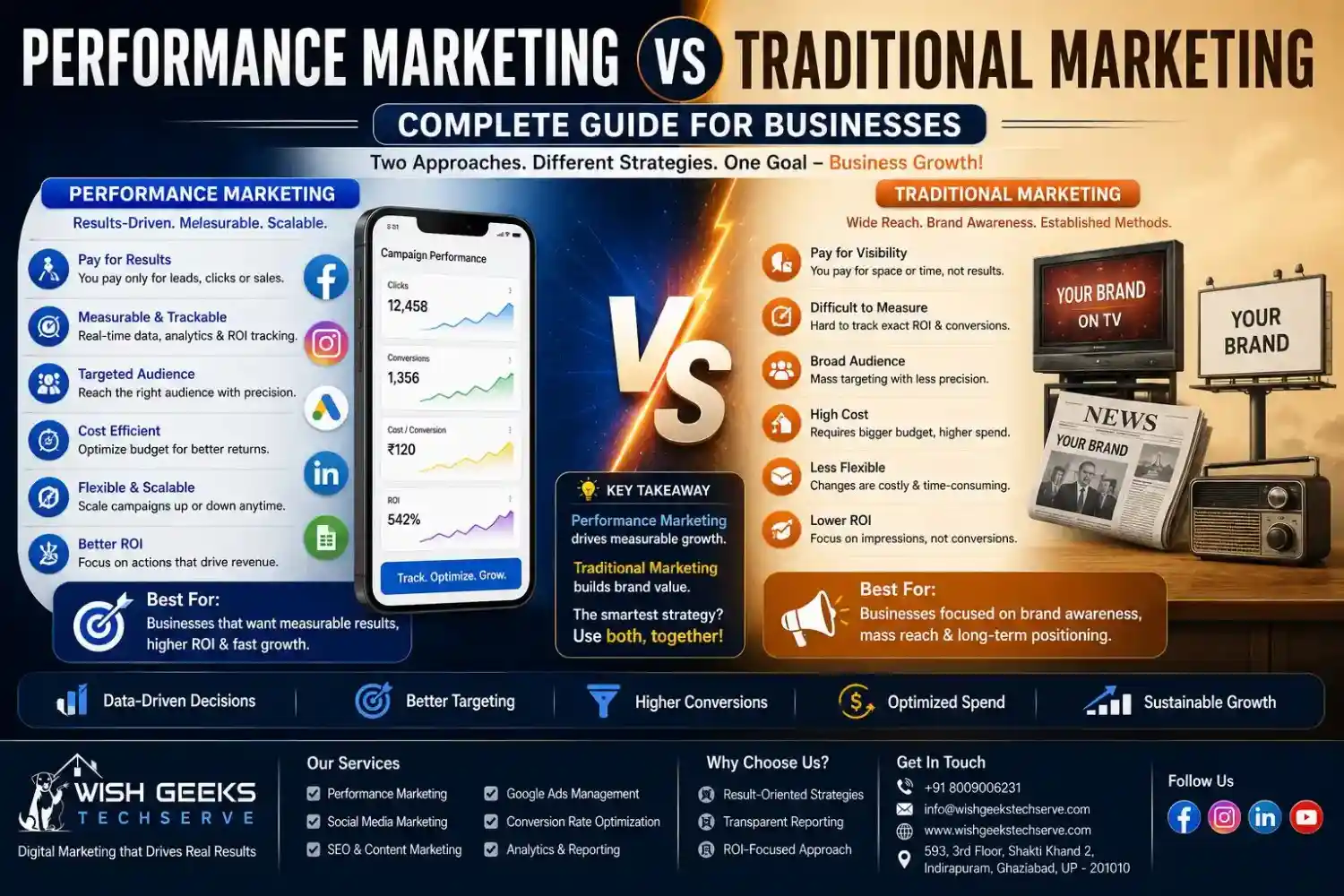
Businesses are always confronted with a dilemma when it comes to Performance Marketing vs Traditional Marketing. One question business owners have to ask themselves is: Am I wasting my marketing budget? You pay thousands of dollars for advertising, and you can't be sure of how many customers you actually acquired from your advertising. Perhaps your competitor is getting the message to the right people at the right time, and you're just hoping for the best. Sound familiar?
In fact, business marketing has transformed. Grandmother's marketing book (TV commercials, billboards, radio commercials) is not the same. It hasn't gone away, however. Now, however, there are two strong strategies vying for your attention: Traditional marketing and performance marketing. It's not a question of which is better. It's the one that is best for your business at this time. And, more importantly, how can you mix them to grow?
Here, we're simplifying all the information you need to know into easy-to-understand terms. Clear, straightforward information that helps you make better marketing decisions, no jargon, no confusion.
Let's begin with a fact that you know. What we're doing for decades is traditional marketing. Think about the last time you saw a billboard on the highway. Or a commercial that plays on your favorite TV show. Or an advertisement in the newspaper. That's traditional marketing. Radio ads, direct mail (the brochures in your mailbox), bus stop ads, and even flyers at your local coffee shop are all part of it.
It's as simple as this: You pay upfront to get your message out there. You pay for ads, design them, and hope they get noticed and remembered. Perhaps they will contact you. Perhaps they'll come to your store. Perhaps they'll do nothing. The challenge? It's difficult to measure what is going on in real-time. You can't determine if 100 people saw your billboard or 100,000 people saw your billboard if you spend ₹4,15,000 on the billboard for three months. You will not be able to determine whether or not any of them actually purchased from you due to that billboard. A survey could be done later, and the question asked, "Did you see our billboard? Even then, however, you're only taking a wild guess.
The power of traditional marketing! It creates brand awareness. If you see the same logo or message over and over, it will be embedded in your mind. Hence, large corporations continue to rely on conventional marketing; they wish their brand to be familiar and trustworthy.
Let's now discuss performance marketing. This is the complete opposite approach. Performance marketing is straightforward; you only pay for results. If someone clicks on your ad, If someone clicks on your ad, You pay. A person joins your newsletter? A person registers for your newsletter? You pay. If a sale was made? You pay. No clicks, no sign-ups, no sales? You pay nothing.
The majority of performance marketing is done online. These are all performance marketing channels: Google Ads, Facebook Ads, Instagram Ads, email marketing campaigns, and influencer partnerships. They are data, technology, and real-time tracking driven. The great thing about this is that you can view everything. If a person clicks on your ad, you know that they are in the vicinity, their age, gender, and interests. You can view the duration of time they spent on your website. It is possible to tell whether they purchased something or not. The amount of profit that each dollar of advertising generated can be computed.
That's why performance marketing is the preferred choice of startups and small businesses. It is safe as you are only charged for results. And when something doesn't go as planned, you can alter it in hours, not months.
To make it easy to compare the two approaches, let me present them in a comparison table:
Aspect | Traditional Marketing | Performance Marketing |
Payment Model | Pay upfront for ad space (newspapers, TV, billboards) | Pay only when a specific action happens (click, sale, sign-up) |
Measurement | Hard to track; relies on surveys and estimates | Precise, real-time tracking of every action |
Targeting | Broad audience (age, gender, general location) | Hyper-targeted by behavior, interests, search history |
Speed of Changes | Slow; campaigns run for weeks or months | Fast; you can adjust campaigns within hours |
ROI Clarity | Unclear; difficult to connect spending to sales | Crystal clear; exact ROI per dollar spent |
Best For | Building brand awareness and trust | Driving immediate sales and conversions |
Cost | Usually, high upfront costs | Lower upfront; you scale with results |
Learning Curve | Simpler to understand conceptually | Requires understanding data and analytics |
Suppose you are a bakery that has just started online in Bangalore, and you want to attract customers.
Traditional Marketing Approach: You advertise on local radio for a month for ₹1,50,000. You want your bakery to be known and for people to come to your website. At the end of the month, you're not sure how many people were attracted to your radio ad. You may be lucky and have more customers that month, but you can't be certain that it's due to the radio.
Performance Marketing Approach: You pay ₹1,50,000 for Google Ads and Facebook Ads for people who live within 10 km of you who have searched for "artisan bakery" or "fresh bread delivery. You know each time someone clicks on your ad. You can determine whether they ordered something or not. Only pay per click or per actual order. If one ad is performing well in terms of clicks but not sales, you can simply discontinue it and move on to another ad.
At the end of the month, you know exactly: "These 150 clicks were from my ads, 15 people ordered, my cost per customer was ₹10,000, and each customer spent an average of ₹800.
That clarity is a game-changer when it comes to decision-making.
Let's explore the reasons why performance marketing is gaining the popularity it's enjoying today.
This is the greatest benefit. No money spent on those who aren't interested in your product. You're not paying for people to see your message; you're paying for actual customer actions.
Different ad message? Test it in hours. New audience? Test it in hours. In traditional marketing, it would take a TV or radio campaign to rotate through to produce results.
If you have found a successful campaign, what did you do to make it successful? Put more funds into it. Campaign not performing? Stop it immediately. You're in control of your money.
Performance marketing is all about data to identify the right audience that is most likely to purchase from you. A 25-year-old who is interested in sustainable fashion is more likely to purchase from your eco-friendly brand than a random person of any age.
It doesn't require a lot of money to get started. If done correctly, even a performance marketing budget of ₹5,000-10,000/month can yield tangible results. If you're willing to spend ₹5,000 on a traditional billboard, you likely won't see much.
There's one thing to keep in mind: Traditional marketing is not dead. It's still used by big, established brands. Coca-Cola continues to purchase Super Bowl ads. Nike still has billboards. McDonald's continues to air commercials on TV. Why? Traditional marketing reinforces that, after you've established your brand online, people already know your brand.
Consider traditional marketing as the building blocks of brand trust and performance marketing as the fuel for acquiring customers.
Truthfully, you have to know whether your marketing is effective or not.
In performance marketing, you have very clear metrics:
For example, if you invest ₹75,000 in Google Ads, 200 people click. 10 people buy. Your revenue is ₹37,500. That's clear data. Your ROAS is 0.5:1. You're aware that you are losing money, and you need to make a change.
This is not the clarity you can get from traditional marketing. You may place a newspaper ad and see that people were coming into your store that week, but did they come in as a result of the ad? You can't be 100% sure.
Performance marketing is suitable for:
We've been able to help dozens of startups and growing companies create scalable performance marketing campaigns that actually produce revenue at Wish Geeks Techserve. We're on a mission to deliver results.
The secret of the smartest businesses is that you don't have to choose. Typically, a combination is the best approach.
For a large company, it could be 60% of the budget allocated to performance marketing (to generate sales) and 40% to traditional marketing (to establish brand authority and reach a wider audience).
A startup could begin 100% performance marketing and then begin to incorporate some traditional marketing as they mature and become more established.
Example: Suppose you are a software company. You are running Google Ads for free trial signups (performance marketing). As your brand becomes more popular and well-known in the industry, you also sponsor industry events and advertise in trade publications (traditional marketing). The two complement each other.
The debate of performance marketing vs traditional marketing is no longer a vs. debate. Traditional marketing established trust and brand awareness. Performance marketing is a way to get sales and immediate results. The companies that are succeeding are not selecting one, but rather are leveraging both.
For those who are just beginning or have a small budget, performance marketing is for you. It's measurable, scalable, and efficient.
If you have a brand established and you want to strengthen your brand, a combination of both is appropriate.
The most crucial thing? Don't just assume that your marketing is successful. Start measuring it. Start optimizing it. Begin to propagate from it.
We are experts at creating performance marketing campaigns that convert at Wish Geeks Techserve. From SaaS companies to e-commerce brands to service businesses, we can help you get the right people at the right time and track every result. Looking to put an end to the marketing money going down the drain and start getting a return on investment? Let's discuss what a performance marketing strategy might be for your business.
Q: Is performance marketing costly?
A: On the contrary, it is cheaper than the conventional marketing approach, as you are charged only for the achievement of goals. You can even start performance marketing with a monthly budget of around 3,000-5,000 and begin seeing results.
Q: Do I have to hire many people to handle performance marketing?
A: Absolutely no! There are many small businesses that use Google Ads and Facebook Ads Manager to operate their advertisements by themselves. It's only that an expert like Wish Geeks Techserve can help you save money through better campaign optimization and less wastage in ad spending.
Q: Is traditional marketing totally out of date now?
A: Absolutely not. Traditional marketing is still a very useful means of branding and reaching out to certain market segments. However, performance marketing gives you a higher return on investment, which is why Indian startups and expanding businesses mostly choose it first.
Q: How can I measure the ROI of traditional marketing?
A: It can be done by means of surveys and coupon codes, but the result will not be as precise as with performance marketing. Most of the traditional advertisements in India stimulate brand surveys rather than direct sales correlation.
Q: What's the best first step for a new business?
A: Begin with performance marketing. It's less risky, less capital investment (₹5,000-10,000 is sufficient to test), and you'll find out what your customers are interested in. After determining a winner, expand the scale.
Thank You for showing interest in our services. Here’s how you can reach us...

info@wishgeekstechserve.com

OUR ADDRESS
Sector-62, Noida, Uttar Pradesh




.7f54be30.webp&w=256&q=75)